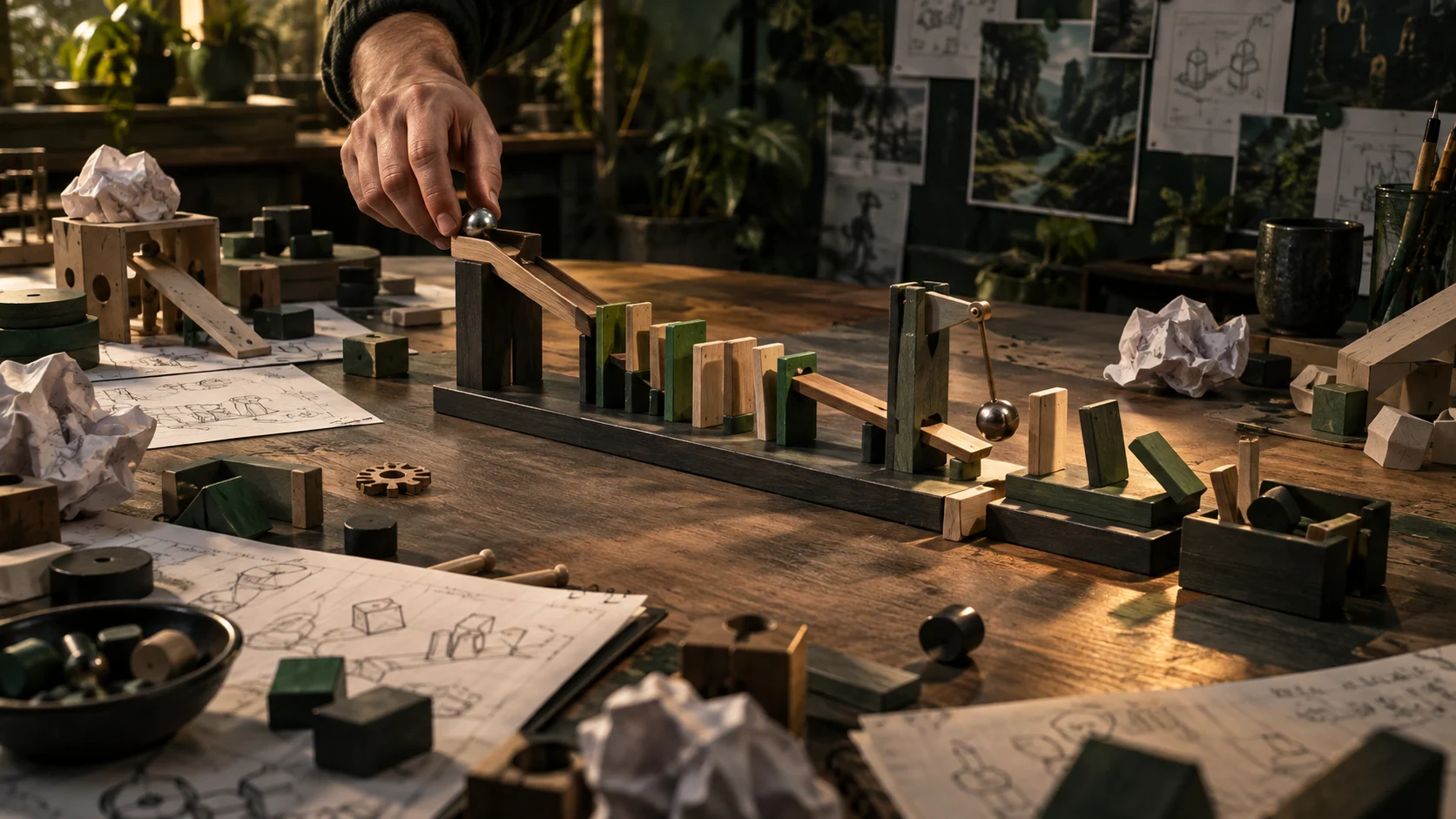
Name the verb the player will repeat
Caveman Taxi is about carrying a passenger through a dangerous route, but the repeated verb is controlling momentum. Super Air Hockey is about scoring seven goals, while the repeated verb is reading the next contact. GridInc is about building an electricity empire through repeated allocation decisions.
If the repeated action is vague, the content plan will try to rescue it. More levels cannot repair a movement model nobody wants to repeat. More upgrades cannot repair a choice with an obvious answer. The verb needs to create its own small argument every time it appears.
The fantasy should explain the rules
Grug's helicopter drops when thrust stops, so its awkwardness belongs to the character and the physics. GridInc earns while the tab is closed because an electricity network should keep operating. BuyoutInc turns a purchase into another visible piece of a private empire.
Theme becomes powerful when it removes explanation. If the story and mechanic disagree, tutorials have to carry the difference forever. A premise that naturally predicts the rules gives every later system a common language.
Look for a decision with a visible consequence
The most useful early interactions create a chain the player can read. A long thrust burst gains safety now and creates a harder descent later. A bank shot avoids the mallet and commits the puck to a return angle. Buying automation saves attention and changes what the next session is about.
That chain creates judgement. Without it, success is mostly execution or waiting. Both can be satisfying, but they need another source of variation before they can hold an entire game.

Failure should make the next attempt more informed
A Caveman Taxi crash can reveal that the landing began with too much sideways speed. A lost hockey point can reveal an open post or a repeated angle. Those failures produce a theory the player can test immediately.
Random punishment hides the theory. So does weak feedback. During prototype review, I ask whether I can explain the failure in one sentence without looking at the code. If I cannot, the game has not yet earned difficulty.
Only then price the production
Once the interaction survives ten minutes, I look at content volume, art, saves, input methods, distribution and live support. AI can reduce the cost of producing those systems. It cannot turn an uninteresting repeated decision into a durable game.
The original creative test stays visible as production expands. Features are judged against the promise that justified the project. That prevents a technically impressive roadmap from burying the reason the game deserved to exist.
I move an idea into production after its repeated action creates a consequence the player can read and respond to. More content only matters after that interaction survives the test.