Start by locating the risk
There are four places to look. The model may have questionable inputs. The production decision may harm workers. Generated material may reach the customer. A live system may create new material after release. Each boundary creates a different duty for the studio.
This is why the industry's apparently contradictory position makes sense. GDC's 2026 survey found 52% of respondents viewed generative AI negatively while 36% were already using it. A developer can use code assistance and still object to unlicensed training, executive cost-cutting or generated storefront spam. Usage does not settle the argument. The conditions of use do.
Valve focuses on what reaches the player
Steam's content survey is a practical example of that boundary. Valve says its focus is generated material included in the game, while efficiency gains from development tools fall outside the survey. Pre-generated art, sound, story and localisation still have to meet the platform's legality and infringement rules.
Live generation receives separate treatment because nobody can inspect every future output before release. The developer has to describe the guardrails, and players can report illegal material. The rule is responding to a specific risk at a specific point in the product. That makes the disclosure useful instead of turning it into a vague badge for any studio that touched an AI feature.
Permission comes before productivity
A faster workflow does not answer whether the model had permission to use the work behind it. Voice and likeness need explicit consent. A studio also needs to know whether private code, prompts or unreleased assets become training data for somebody else's service.
These are procurement questions before they are creative ones. Which model is approved? What are its data terms? Can the studio document the origin of a shipped asset? If those answers are weak, the saved hours do not make the risk acceptable.
Quality is a different argument
Lawfully produced work can still be awful. The text can repeat itself, an image can lie about its geometry and code can pass a test that never examined the real failure. Cheap generation increases the number of candidates. It also increases the amount of weak material that can be published without reflection.
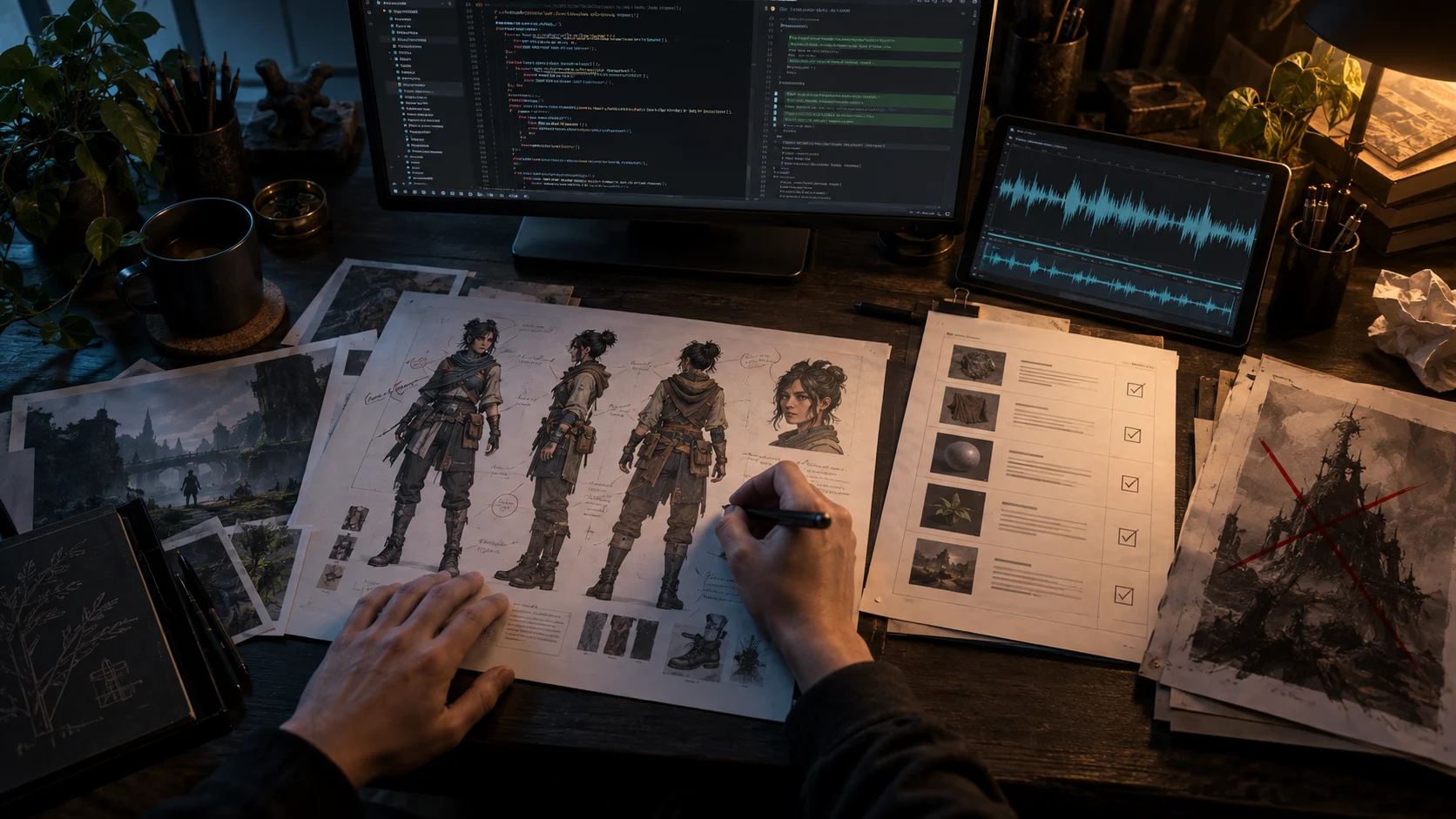
That problem needs editorial control and independent review. At Saratoga Games, generated work begins as a proposal. Visuals are inspected at the size and place where they will appear. Code is tested in the compiled game. A failed direction is recorded so the next attempt does not repeat it. The tool supplies options; the production system decides what earns a place in the game.
The labour concern is real
Executives can use AI as cover for cutting experienced people, then leave a smaller team to repair cheaper output. That is not an imaginary fear. It is also a poor operating model. Removing the people who understand the product destroys the judgement needed to direct and review the faster production system.
The economic pressure still exists. Studios compete on time, capital and the number of serious ideas they can test. Teams will automate repository investigation, test setup, production analysis and routine implementation. The better question is who benefits from that speed, which decisions remain owned by experienced people and whether the resulting work is actually better for players.
The standard I expect studios to meet
AI-assisted creation is staying because the economic advantage is too large to ignore. The label will become less useful as these capabilities move into ordinary editors, engines and production software. Policies will have to become more precise about model provenance, player-facing material, identity, live generation and accountability.
My standard is straightforward. Use models with terms the studio can defend. Obtain consent for identity and performance. Keep experienced people responsible for creative decisions and labour consequences. Disclose generated material when it reaches the audience. Review the result more rigorously because fast generation creates more failures as well as more useful options.
The credible position is conditional adoption: prove the inputs, protect the people affected, disclose what reaches the player and keep a named human responsible for the result.