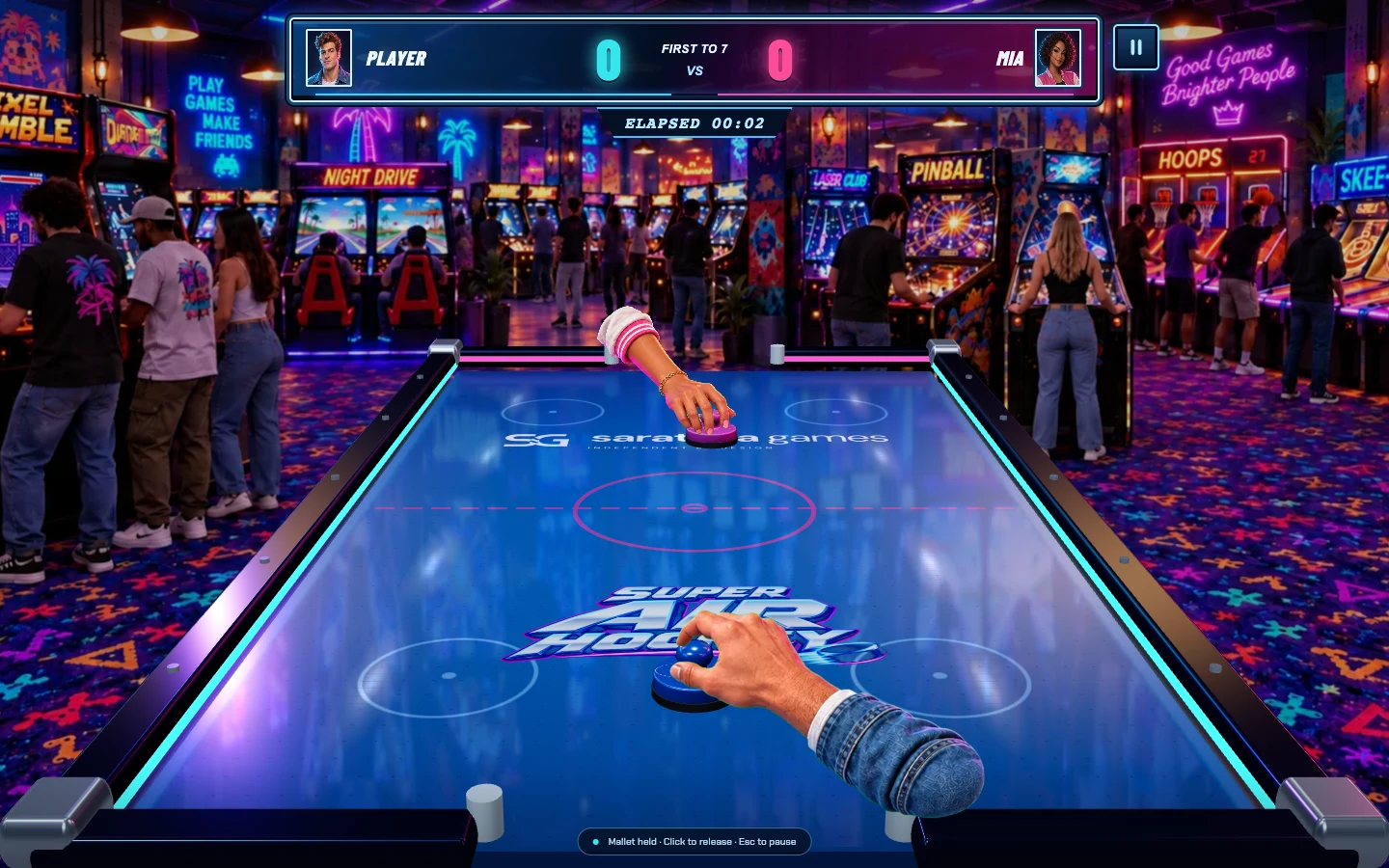
Move the mallet
With a mouse, trackpad or touch screen, press on the table and move to guide your mallet. Mouse play uses a held grip so you can keep moving naturally even when the pointer would otherwise reach the edge of the canvas. On touch screens, your first contact keeps its offset from the mallet, which helps your finger stay out of the way.
Keyboard play uses the Arrow keys or W, A, S and D. Press P or Escape to pause, and M to mute. The mallet stays on your half of the table in every control scheme. That boundary is part of the game, so attacking well means striking from your own side rather than chasing through the centre line.
- Mouse, trackpad or touch: press and move
- Arrow keys or W, A, S and D: move
- P or Escape: pause
- M: mute
Build your defence from the centre
After a shot, bring the mallet back toward the middle of your goal side. The centre gives you a short path to either post and stops a simple return from finding an empty net. Parking directly inside the goal mouth can work for a moment, but it gives you less room to meet the puck and control the rebound.
Watch the puck rather than the rival mallet. A puck travelling toward a side rail will keep its speed and return at a matching angle. Start moving toward the likely rebound point while it is still crossing the far half. That early read matters more than a frantic save at the last second.
When the puck reaches you slowly, use a soft touch to settle it. A fast swipe adds energy. A small, controlled movement can block the lane without sending the puck straight back to a waiting rival.
Choose between direct shots and bank shots
A direct shot is strongest when the rival has drifted away from the centre. Strike through the puck toward the open side of the goal. Moving sideways across the puck creates a glancing contact, which is useful for changing its line without always adding maximum speed.
Bank shots are valuable because the rival has to read two pieces of the journey. Aim at a side rail so the rebound crosses behind the mallet or reaches the goal from a sharper angle. The table rails preserve most of the puck's speed, so a clean bank still arrives with purpose.
Avoid repeating the same corner. The computer rivals predict incoming lines and become quicker, more accurate and more aggressive as the difficulty rises. Mixing direct attacks, single banks and patient resets makes your next shot harder to anticipate.

Treat every serve as a free setup
The puck is placed at rest for the player who serves. Use that pause to decide where the first opening will come from. You can line up a straight hit, approach from an angle, or nudge the puck into space before committing.
Do not rush simply because the rival is ready. A controlled first contact gives you possession and keeps the puck away from your own goal. The same principle applies after a loose rebound. If you have time, improve the position before you swing hard.
Pick the right difficulty
There are five levels: Easy, Medium, Hard, Expert and Pro. Higher levels shorten the rival's reaction time, increase movement speed, reduce aiming error and create more attacking pressure. The puck follows the same physical rules at every level.
Easy is useful for learning angles and control. Medium asks for a dependable recovery position. Hard and above punish repeated shots and slow returns to goal. Move up when you can explain why you conceded most points. If every goal still feels surprising, another match at the current level will teach you more.
Choose a mode with a purpose
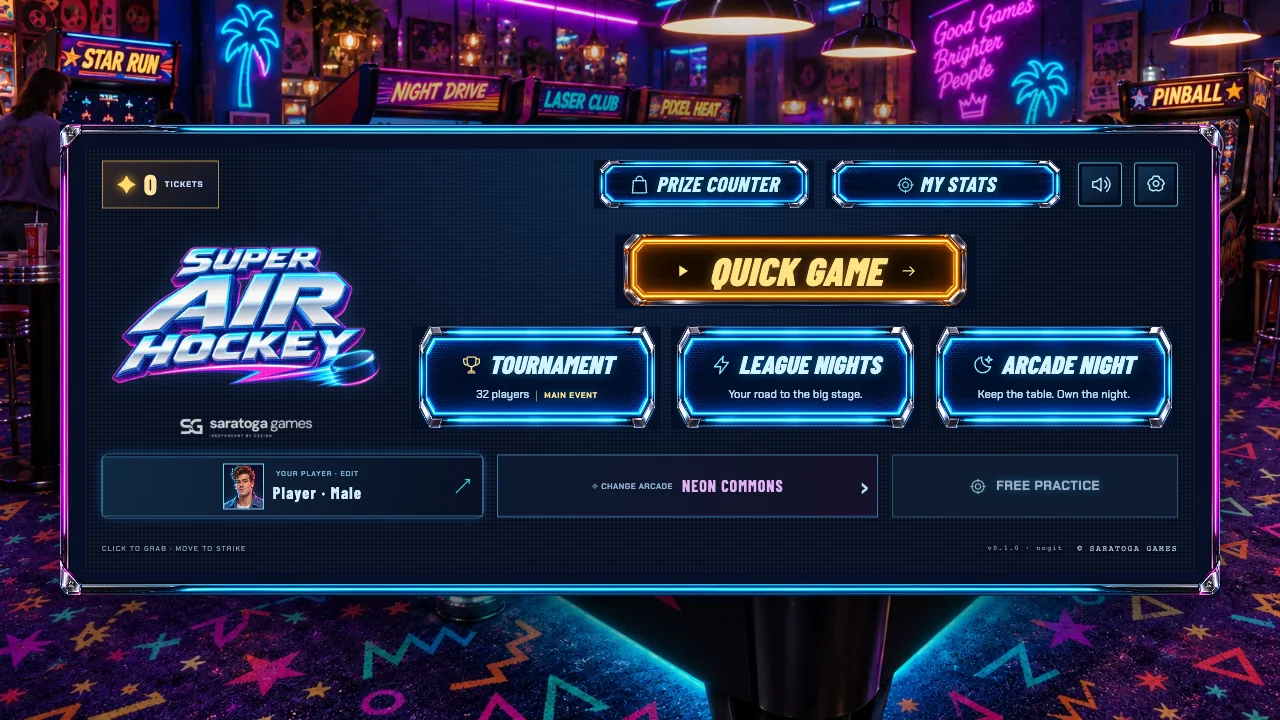
Quick Game is the fastest route to a race to seven. Practice gives you an open table for control and angle work. Tournament places you in a 32-player bracket with 31 computer entrants. League Nights provides a longer climb, while Arcade Night tests how far you can carry a streak.
Matches earn tickets that can unlock mallets, pucks, table finishes and effects. Those choices change the look of your setup. The competitive difficulty remains in the simulation. Progress is stored locally in your browser, with no account required.
A three-match practice routine
In match one, return to the centre after every attack. Ignore the final score and count how often your goal has proper cover. In match two, attempt one bank shot whenever the puck settles in front of you. In match three, combine both habits and play normally.
That short routine gives each match a job. It also makes improvement easy to notice. Your defence becomes calmer first, then the extra time creates cleaner attacks.
Recover to the centre, read the rebound early, and vary the path to goal. Good positioning gives you the time to make a better shot.